


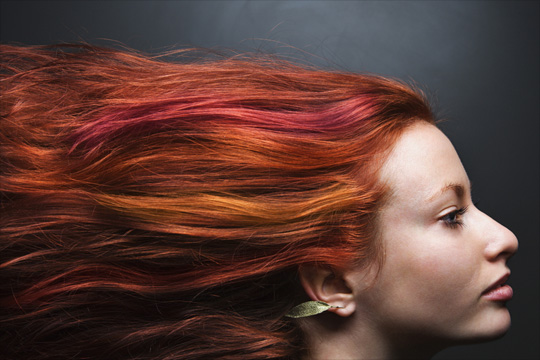
Are you ready to turn that bottle blonde to a defiant brown? Or does that daring platinum call your name? When you and your hair are ready for a new shade, you’ll want your choice to last.
After a color change, it’s easy to get frustrated when once vibrant, glowing tones turn dull and fade, but with a few simple steps and perhaps changes to your routine, you can put off your next visit to your stylist for three weeks or more.
Watch out for these hair bears that can take your locks from VA-VA-VOOM! to boring in no time flat.
 It’s repeated ad nauseum, but that’s because it’s true: the wrong shampoo and conditioner can wreak havoc on hair. Just like you wouldn’t give a moisturizer with mineral oil to someone with oily skin, you shouldn’t use sulfate-rich shampoos and conditioners on color-treated hair.
Sulphates are rather harsh surfactants (they’re one of the things that make shampoos lather) which strip product and oil from hair. And they can also do the same to color. Shampoos and conditioners formulated for color-treated hair have much lower levels of gentler sulphates (while many also contain natural cleansers to supplement this) that are better for daily use.
If you prefer not to use any heavy products on your hair at all, look for sulphate-free shampoos; they’ll preserve color even longer, but they may not be able to tackle product buildup (and don’t expect a foaming lather).
 Styling products work by coating each strand of hair, and as many contain chemicals and oils, merely rinsing in water might not remove them. Products built up over time can leave your locks dull and limp. That’s where a clarifying shampoo comes in.
Normal clarifying shampoos are basically like dish soap. They contain extreme levels of sulphates and harsh stripping agents that can literally make color-treated hair ashen. Higher end companies and beauty supply stores, however, stock clarifying shampoos and treatments for more delicate hair. They rely on strong, natural extracts and oils (grapefruit being the most common) to gently dissolve buildup while nourishing the hair and smoothing the cuticle.
If you use shine products, keep in mind that silicones, while temporarily good for giving hair a mirror-like reflection and for smoothing frizz, can build up quickly over time, coating the cuticle, and making hair heavy, flat, and lusterless.
 The sun is a fickle mistress, huh? It can burn our skin, yellow our nails, and now it can dull our hair, too? Well, yup. UV rays are extremely damaging to colored hair (especially to darker shades), leaching the life out of locks and making strands brittle and dry. But it’s easy to remedy with a leave-in treatment or spray containing UV-protection (basically, sunblock for your hair!). Many companies are now formulating UV-protecting shampoos and conditioners; however, if you spend much time outside, they shouldn’t be your hair’s only defense.
 Heat styling and volumizing products both do some of the same things. They open the cuticle and make hair porous. Heat does it by making the hair cuticle expand; volumizing products do it by forcing open the cuticle and making strands appear thicker. Both of them allow color to escape.
Look for volumizing products manufactured for color-treated hair, which work by lightly coating the strands instead of expanding them.
Just by washing your hair in hot water, the cuticle can open enough for even mild sulphates in color-protecting shampoos to reach and strip away the molecules of color within the hair shaft. To stop it, rinse your hair in the coldest water you can tolerate (step out of the water stream and just dunk your hair under). Doing this with icy water will leave an incredible natural shine on hair as it seals in moisture and smooths the cuticle completely (and it tames frizz at the same time!).
Then, when blow-drying, aim the nozzle down the shaft to avoid damaging the cuticle, and blast hair with the cold setting once it’s bone-dry.
[Continue reading…]







 from Tabs.
